About
Lisa McCormick is a leading figure in the cultural sociology of the arts. She is Senior Lecturer in Sociology at the University of Edinburgh (UK) and a Faculty Fellow at the Center for Cultural Sociology at Yale University (USA).
Her book, Performing Civility (Cambridge University Press), is the first sociological study of international competitions in classical music, and she is currently co-editing the Oxford Handbook of Competition in Music (Oxford University Press), a multi-disciplinary volume that lays the foundations for a new research field of competition studies. An engaging speaker, she has addressed the General Assembly of the World Federation of International Music Competitions and discussed her research on BBC Radio 3. During the 18th International Fryderyk Chopin Piano Competition in Warsaw (Poland), she co-hosted “Chopin Talk” with John Allison (Opera Magazine), which was broadcast over YouTube to a global audience of millions.
She grew up in Lethbridge, Alberta, a small town on the Canadian prairies whose claim to fame is the tallest and longest railway bridge of its kind in the world. Her undergraduate studies were at Rice University, Texas (USA), where she completed a BMus in Cello Performance and a BA in Sociology, both summa cum laude. She then obtained an MPhil in Music (with distinction) at the University of Oxford (UK) as a Rhodes Scholar (Prairies & Corpus Christi 1998). After receiving her PhD in Sociology from Yale University, she taught at Haverford College (USA) where she was tenured and promoted to Associate Professor.
Since joining the School of Social and Political Science at Edinburgh, she has expanded her research agenda, taught at all levels of the curriculum, and mentored junior colleagues in postdoctoral and sabbatical projects. Her service to the discipline includes co-editing the journal Cultural Sociology and serving on the editorial board for several journals, including Sociological Theory and the American Journal of Cultural Sociology. An active member in professional associations on both sides of the Atlantic, she chairs the History of Sociology and Social Thought Section in the American Sociological Association, and she serves on the steering committee of the Sociology of the Arts Study Group for the British Sociological Association.
Music remains a big part of her life. Her research in the sociology of music is informed and inspired by her background in classical music and her ongoing participation in musical life as an orchestral musician, chamber-music collaborator, and regular concert and operagoer.

Books
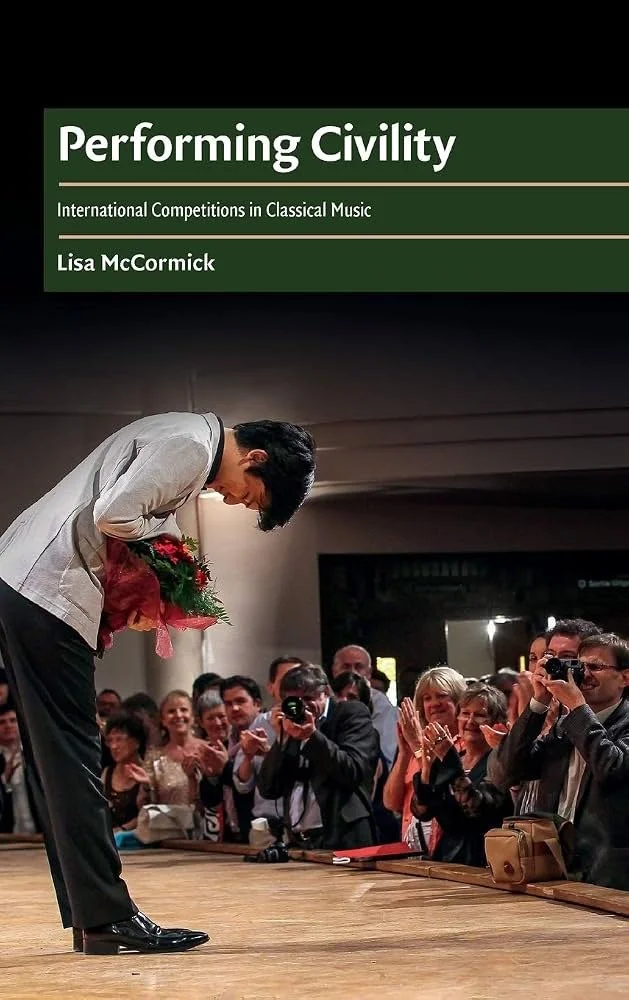
Performing Civility
Cambridge University Press 2015
Although competitions in classical music have a long history, the number of contests has risen dramatically since the Second World War, all of them aiming to launch young artists' careers. This is not the symptom of marketization that it might appear to be. Despite the establishment of an international governing body, competitions are plagued by rumors of corruption, and even the most mathematically sophisticated voting system cannot quell accusations that the best talent is overlooked. Why do musicians take part? Why do audiences care so much about who wins? Performing Civility is the first book to address these questions. In this groundbreaking study, Lisa McCormick draws from firsthand observations of contests in Europe and the US, and in-depth interviews with competitors, jurors and directors, as well as blog data from competition observers to argue that competitions have endured because they are not only about music, they are also about civility.
'Offering a peek into the fascinating world of international classical music competitions, Lisa McCormick’s Performing Civility highlights the sociological tension between combat and civility. A rich, masterful study of performing, judging, and listening. Bravo!'
Eviatar Zerubavel - Rutgers University, New Jersey
The Cultural Sociology of Art and Music
Palgrave Macmillan 2022
This edited collection develops the Strong Program’s contribution to the sociological study of the arts and places it in conversation with other cultural perspectives in the field. Presenting some of the newest and most original research by both renowned figures and early career scholars, the volume marks a new stage in the development of the cultural sociology of art and music.
“This book elegantly demonstrates how fecund cultural sociology might be when its different traditions and factions are brought into real dialogue with each other. Through a series of engaging case studies and thoughtful theoretical discussions, it points the way to a renewal of the sociology of art and music.” (David Hesmondhalgh, author of “Why Music Matters”)
Myth, Meaning, and Performance
Paradigm Press 2006, Reprinted by Routledge 2016
The cultural and performative turns in social theory have enlivened sociology. For the first time these new developments are fully integrated into new approaches to the sociology of the arts in this important new book. Building on the established research into art worlds, what is interesting for the new sociology of the arts, understood in the broad sense to include popular culture as well the classical focus on music, painting, and literature, is the relationship between art works and meaning, myth, and performance. Also reflected in these rich essays, which range from Beethoven to John Lennon to Chinese avant garde artists, is the lived experience of the artist and its impact on the process of creation and innovation.